
“There is no such thing as a bad piano, just bad pianists,”
My teacher in undergrad used to tell me this over and over again. To some extent this is true: a great pianist should be able to make even the shyest of pianos sing. There are videos of professionals on Youtube making the most beat-up street pianos sound good. However, I personally believe that for strong growth and proper development, a student must have access to a good quality instrument.
If we take a student who is still learning, and we provide them with only a terrible instrument, growth just won't happen. Bad habits will form technically and the student’s aural skills will be incorrect, handicapping the student.
I grew up practicing on a cheap upright piano. The piano was almost a half-step flat, maybe 15-20 cents flat from the standard 440hz tuning. As a result, it was incredibly hard for me to hear and accurately match pitches. It took me four years of consistent practice to change my inner intonation.
In this article, I examine the history of the piano, why it was invented, and the mechanisms that make the piano work. These mechanisms include the Action, Sound, Size, and Pedals of Upright and Grand pianos.
The final part of the essay discusses the pros and cons of the various types of pianos for students, from my own point of view, and their effects on a student’s development and psychology as a pianist.
These include reflections from my own experience of starting out on a 55-note keyboard at the age of 7, all the way to a 9-foot Steinway D Concert Grand, 14 years later.
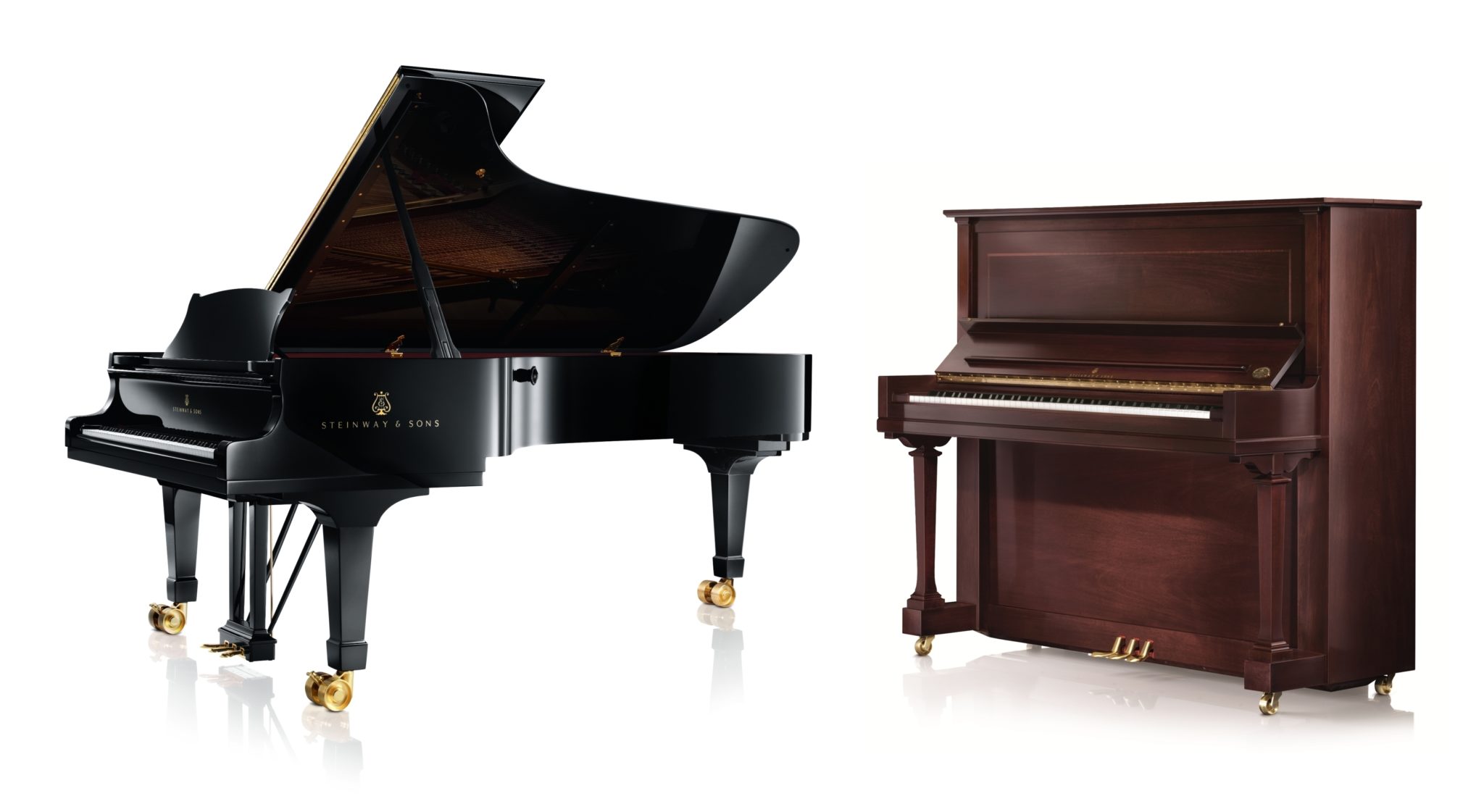
Note: When we are talking about upright pianos we are stereotyping the vertical piano family into one word. There are actually four pianos in this family. From smallest to largest: The Spinet, Console, Studio, and Upright. For the sake of simplicity I will refer to them as Upright Pianos.
History:
The story of the piano begins 300 years ago, in Padua, Italy in 1709. It was invented by Bartolomeo di Francesco Cristofori (1655-1731).
The reason for the development is simple: before the piano we had this instrument known as the Harpsichord. The problem with the Harpsichord? Only one dynamic volume could be played at a time. The strings are plucked, rather than struck, when the player presses the keys. No matter how hard or soft the key of the Harpsichord is struck, it plucks the string the same amount of force. The only way to change volume on the Harpsichord is to play more or fewer notes.
The piano does not pluck the string, the piano strikes the string with a hammer when the player presses down the key. Depending on how the key on the piano is struck by the player: how hard, fast, soft, slow, and so forth, changes how the hammer then hits the string, which thus changes the volume and sound quality. This mechanism is known as the Action.
Grand Piano
Action:
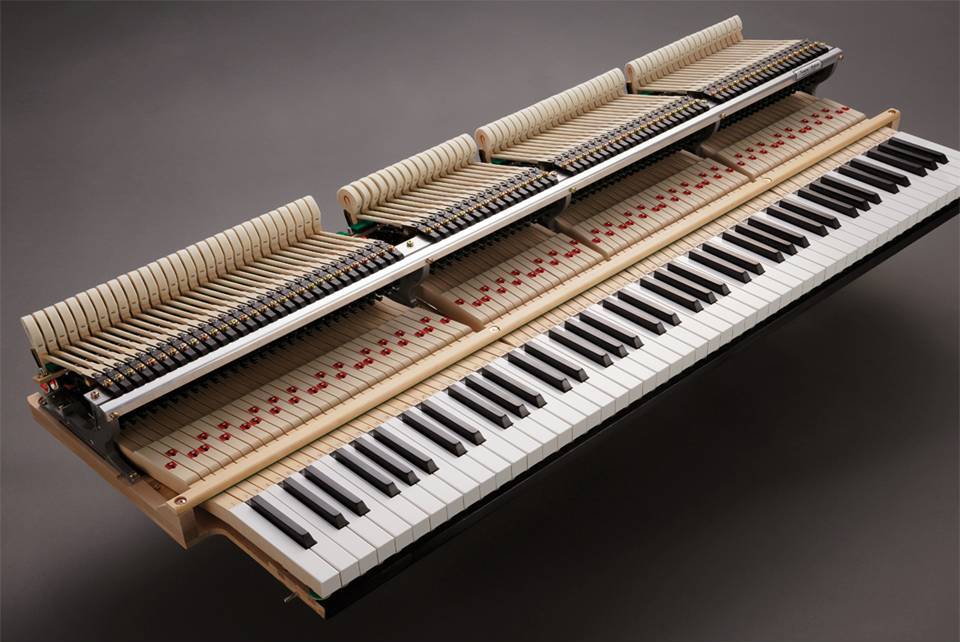
Before we get any further, please take a minute to acknowledge how unbelievably sexy this modern day Kawai grand piano action is. The hardware is black with gold screws! How cool is that! Keep that image in mind because we will first discuss the upright piano action.
Upright Piano
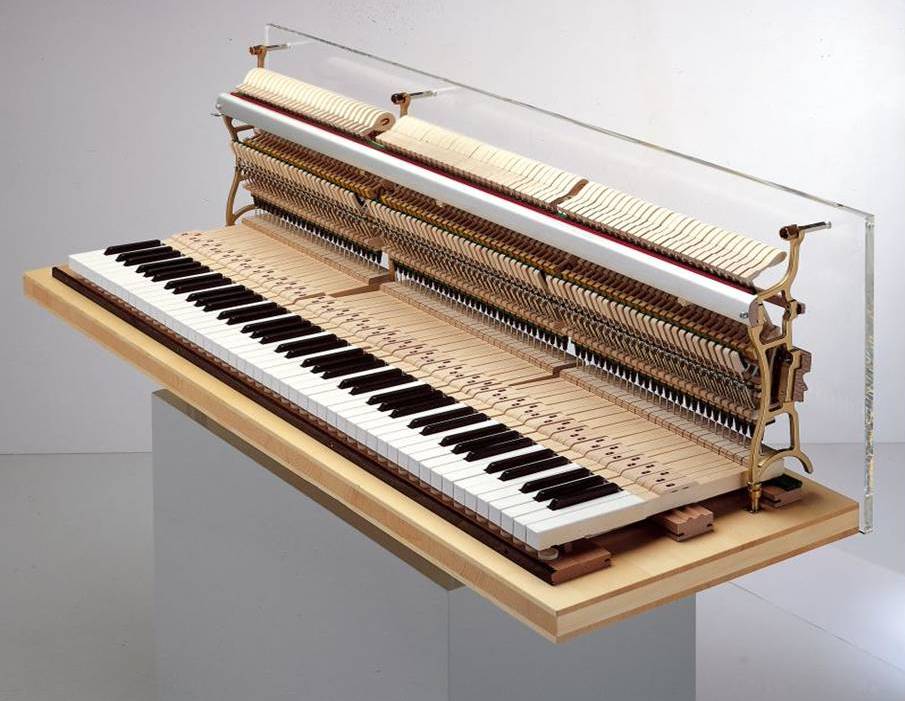
- The piano action: is a mechanical system that operates by pressing the piano keys, which then engages levers, that moves a felt hammer to strike the corresponding string when the key is pressed.
- The strings are made of high tempered steel and are generally tuned to the standard concert pitch, A=440hz.
- The hammer is made of felt and is very tough.
- The constant striking helps aid in slowly releasing pressure on the pinblock, detuning them.
- Strings are to be tuned once every 3-6 months, depending on how much you practice and perform.
The upright pianos action sits vertically, as well as the strings.
- The keys rest horizontally, are very long, and when a key is pressed down, it lifts on the other end like a seesaw.
- This then moves a bunch of parts, that then moves the hammer forward striking the string horizontally.
- The damper lifts horizontally as well, but the damper is not in this image.
- Once the key is released, the hammer resets with the aid of springs and the damper resets too.
The grand piano's action rests horizontally, as well as the strings.
- When the key is pressed down, it lifts on the other end, moving a bunch of other parts, similar to an upright, but the hammer moves vertically to strike the string.
- This offers more control of dynamics, color, speed, and overall force.
- The damper lifts vertically as well.
- When the key is released, the hammer and damper fall and reset thanks to gravity.
The action on a grand piano is faster because the action moves with gravity.
A grand piano does not have a spring that needs to be reset, and as a result it can be played again at virtually any distance. An upright piano key has to come up a certain distance to reset the spring before you are able to restrike that same key. If we take a high quality grand, and a high quality upright, and play the same amount of hours on each instrument, the odds are that the upright will need those springs replaced while the grand continues to flow with gravity.
Note: Consistent practice/movement causes all parts to weaken, and slow down over time, regardless of quality. You can swap actions on a grand piano with ease. Some pianists own multiple actions with specific voicing and key weight for each one. Actions are very expensive though and a new one can start as high as $15,000.
Sound:
Sound is why we play music. If the sound isn’t good, we will obviously question our playing. The reality is a lot of pianists have a decent touch, but if the instrument isn’t in good shape and tuned, it's going to be a discouraging experience.
I will always recommend a grand over an upright, if you can afford it, even if you reside in a little apartment.
If your home has limited square footage, you may be asking yourself “well doesn’t sound need room to travel?” It's true, sound does need room to travel, but if you stick a 9 foot concert grand in a storage room, and also place an upright in that same room, the 9 foot will still be a more enjoyable aural experience.
In fact, I used to practice in a storage room with a Steinway D, and you know what? I LOVED IT. Why? Because the sound was so unbelievably powerful. The hard hitting sustaining bass that you can feel in your bones, the overtones screaming in your face, and a very pleasant aroma from the wood was an overall very powerful experience.
Steinway D
An average piano has 230 strings, their tension is maintained on the pinblock, and the sound reflects off a piece of wood called the soundboard. The size of the piano will determine the size of the soundboard, and string length. The larger the piano, the bigger the soundboard. This requires longer strings which will result in more volume, resonance, and sustain. In other words, the bigger the size, the more sound you have.
Also, the soundboard carries an incredible amount of pressure, and with more size, comes more pressure.
With this theory, a grand piano is always going to be louder than an upright.
The largest upright still has a string length of a couple inches shorter than the smallest grand pianos strength length. However; sound can be affected by multiple things, and these are some key spots to check out when shopping for a piano.
Factors that might affect the sound of your piano:
- Dust on the strings:
Yes, believe it or not dust plays a major factor in a piano's sound. A lot of problems can be solved by removing the dust from the strings, dampers, and soundboard.
Ex: Non-sustaining notes, super bright or harsh notes, or just lack of overall sound, can generally be corrected with the removal of dust. You would be surprised!
An upright piano isn’t going to need dusting as often as a grand. Unless of course you practice with the top of the lid open, and it remains open, or if you choose to remove the whole front cover exposing the action and strings.
A grand piano is going to accumulate dust much quicker and will need dusting rather often; once or twice a month. Unless of course, you keep the piano completely closed forever, but I don't know anyone who keeps their grand piano closed.
It's really simple to dust a piano and doesn’t take more than 5 minutes. If you absolutely hate the idea of having to dust your instrument, then undoubtedly buy an upright.
2. Hammers:
Check out the hammers when you are shopping for a piano. If you are having trouble controlling your pianissimo, or if the tone sounds very dull, there's a good chance the hammers have deep grooves that need to be filed, plus dust removal! 🙂
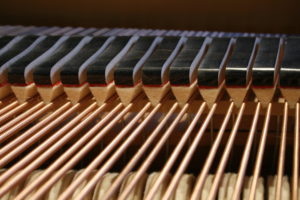
Hammers
3. Intonation/voicing:
If the hammers are round, and there is little to no dust on a piano, and it still sounds dull, or very bright and hard hitting, you have one of two options. Either the piano needs a serious tuning with a good technician and/or the hammers need to be voiced.
Note: If you purchase a piano and it sounds great in the store, but when it arrives at your house, the sound is disappointing, have no fear! A simple voicing will most likely solve this problems. The felt on a hammer needs to be adjusted according to the room it rests in. If your tone is very bright, or if the tone sounds like the hammer is hitting the string hard, it means the felt is too tough and needs to be loosened. If the tone is very dull, and sounds weak, it means the felt is too soft and will need to be hardened. This should be done by a technician.
Space/Size:
I shared with you that I used to practice on a Concert Grand, in a storage closet, and I loved it. The reality is, most people can’t afford a Concert Grand, and even if you could, there's honestly no reason to buy one, unless of course you are completely infatuated with having that much sound in your face.
Regardless of space, I will always recommend a grand over an upright for an overall better experience. I personally get frustrated with uprights. For me, the only reason to practice on an upright is if: A) It's the only option available or B) just to get my notes learned.
Grand pianos start as small as 4’ 11”, these are also known as the “baby grand,” which will require only 6-1/2’ x 5’ of space. That’s pretty doable for most people. If you truly don’t have enough space for a grand, or if you really just don’t want one, purchasing an upright can be a great investment too.
Count Basie, a prominent jazz pianist, said in an interview with Oscar Peterson, another prominent jazz pianist, that he prefers uprights over grands due to the keys being lighter.
When it comes to uprights, I would recommend buying quality and the largest size you can afford. This way you won’t have to purchase another one. A quality piano can last a lifetime and then some if you keep up on maintenance. I have played upright pianos that date back to the 19th century and they still play pretty well!
A bad quality upright is going to cause frustration after a short time because of cheap parts, especially a cheap action, a lack of projection in the sound, and most technicians will charge more to work on the piano than the value of the instrument. You will inevitably want to buy a new one. In other words, you will still end up shelling out the cash eventually if you decided to 'save money', or worse, you may quit. :'(
Note: A grand piano's sound doesn’t truly open up until the six foot mark, allowing you to “feel” the sound. Anything under six feet will have limitations in its overall power. If you are not aspiring to become a professional pianist this does not matter. However, if you wish to strive for the concert stage I would recommend 6’ or more. Yamaha claims the C3, 6’ 1”, is the most purchased practice piano for professional piano players around the world.
Pedals:
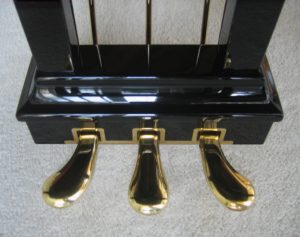
The pedals on an upright and grand piano serve the same purpose, but in different ways:
- Damper Pedal
- This pedal, all the way to the right, lifts up the dampers, allowing the strings to sustain the notes played until the dampers are placed back down on the strings, or until the notes die out.
- The only difference between an upright and grand for this pedal is on a grand, the dampers lift vertically, on an upright they lift horizontally.
- Sostenuto Pedal
- This is the pedal in the center.
- Play a note, or notes, and while holding down the note/notes, press down on the sostenuto pedal.
- The sostenuto pedal holds only this note, or notes, and allows you to freely play, and release, all other notes on the piano.
- You can even use both the sostenuto pedal and damper pedal together. I like to think of this pedal as a stationary third hand.
- There is no difference between an upright or grand piano in terms of function for this pedal. However, I have personally noticed that on an upright piano the sostenuto is not as firm in holding the specific note/notes.
- It is more common for other notes to bleed into the sound on uprights. This problem could be due to the sostenuto pedal needing maintenance. I recommend checking out this pedal when shopping.
- Una Corda Pedal
- This is the pedal all the way to the left.
- This pedal has different functions on an upright versus grand.
- The point of the Una Corda is to change the color and to soften the sound. Some people will refer to this pedal as the soft pedal, although I feel this is a premature statement.
- On a grand piano, the Una Corda shifts the entire action to the right. This movement causes the hammers to only hit two strings instead of three. Yes, this can soften the sound, but it you apply a tad bit more pressure, after engaging the Una Corda, you can match the sound as if it wasn’t engaged.
- The noticeable difference then is, in fact, a change in color and character. This is why I personally don’t like to refer to it as the soft pedal.
- On an upright piano, the Una Corda works much differently. Remember, an upright piano's hammers strike horizontally, so when pressed the Una Corda moves the hammers closer to the strings, shortening the distance, which limits the velocity. It also changes the feel in the action.
- When this pedal is pressed down on an upright, it is easier to play faster due to the shorter distance. The term “soft pedal” is more appropriate when talking about an upright.
Cost/Purchase:
Right now, November 2017, is a great time to buy a piano. I live in the United States and currently, the market is extremely saturated.
When shopping for a piano, remember a couple things:
- Play the piano for at least an hour. Really dig into the keys and listen to how it sounds. Make sure all the keys come up at the same speed and try to get different tones out of the piano. Make sure it can play both harshly and beautifully.
- Check the pedals and make sure they all work. Check that all the dampers lift evenly, the sostenuto pedal has little to no bleed, and that the una corda is doing its job correctly.
- Run your finger on the soundboard to see if any dust comes off. If so ask the dealer to clean it for you. (If the piano has a lot of dust on it, then question the dealer as to why they haven’t been keeping up on simple maintenance!)
- See if the hammers are grooved and if so, demand that they be filed before delivery to your home.
- Tell the dealer you want your technician to come in and look at the piano, even if you don’t have a technician. This simple question can expose a crook. An honest dealer will invite you to bring in your technician, a crook will give you some excuse as to why you can’t.
- HAGGLE! No matter what the list price is, a dealer will inevitably come down. Never, and I repeat, NEVER pay the list price for a piano. If you do, you are making a mistake. When I purchased my Yamaha C3 it was listed at $12,500. I payed $8,000. Now this was a used piano, so it had a lot more room to play. A new piano will be more firm, but nonetheless the market is saturated, and if a dealer has had a certain instrument for a long time, they will have to take what they can to keep their inventory moving.
Be aware that a new, quality, upright can be pricey. New uprights can start at a higher price than used grands. When searching for a new piano I would recommended taking some time, and checking all available options. Even if you find a piano that you absolutely love, and can afford, take a day or two to come down from the excitement, and try it again before making your purchase.
Warning: Don’t ever buy a new Steinway Upright. They are priced very high at $20,000-$25,000 and are awful.
The Aspiring Pianist: How To Choose A Piano For The Advanced Pianist
A lot of people and parents are often confused when you try to explain the necessity of needing to upgrade the instrument once a certain skill level is reached. This includes different sizes in grand pianos too.
The Keyboard:
I began taking formal piano lessons when I was 7 and I started on a Yamaha PS-55 Keyboard. I still have it to this day. I would advise learners, or parents, that if you, or your son or daughter, are on the fence about committing to piano lessons, or if you are a parent forcing them to take lessons, a keyboard is honestly a safe start. However, I recommend one with weighted keys instead of a cheap 80’s synth, so you can begin developing hand strength from the start.
If you, or your child, is evolving at a quick rate, then purchase a quality upright after about a year and see where it goes from there. If you decide in the future to quit, and you have a quality instrument, you can sell it and get a lot of your money back.
The Upright:
After a year my parents bought me a cheap, small, Wurlitzer Upright Piano. Two large men were able to carry it with ease. This would be my piano until I went to college. This upright piano was good to me for 5 years.
To be honest, I didn’t practice as much as I should have during my Elementary School years, but once I got to middle school, I began studying with a new teacher and really began to get serious.
After just two years of consistent practice under him, I reached the world of Bach Inventions, Mozart Minuets, Expressive Etudes, and even some easier Chopin literature. This kind of literature is the turning point. When you reach this level you have two options, either A) you can upgrade to a better, larger, upright piano with a fresh action, or B) buy a baby or grand piano.
- A) If you are looking for a new upright, check for response. You should have good control of the staccato, legato, portato, tenuto, crescendo, decrescendo, and have control of the shape of the phrase, also known as slurring. I’m sure at this stage you, or your child, wants the sound to be more responsive, more resonant, and have more power.
Response is equally important as a good action because you don’t want to get frustrated with a lack of sound, this can lead to injury. The more your ears develop, the more hungry you become.
- B) Purchase a baby grand, small grand, or grand piano. A baby grand is anything under 5’2”, a small grand is classified as anything under 6’, and a grand is classified as 6’ and above.
The Grand:
A smaller grand piano doesn’t automatically classify as superior to a quality upright. In fact, I played an upright from around 1885-1895. It was one of the most incredible feeling keyboards I ever touched in my life, contradicting the notion that vertical actions are superior to horizontal actions; the downfall came in the sound.
The sound was so soft no matter how much speed I put into the thrust of the chord. I kept trying to push the sound harder and began hurting my shoulders. The instrument was good for certain situations, but not for what I wanted.
Note to Parents: If your son or daughter is persistent with becoming a pianist as a profession, please support them. I know it sounds risky, but if they're dedicated they can have a really great and prosperous life.
Good luck on your search and if you ever have any questions feel free to drop your comments below. I can talk about this subject all day, and then some!
Liked our article? You can also check out our detailed buying guide on Acoustic Piano vs Digital Piano for beginners and experienced piano players comparing sound quality, aesthetics, price, upkeep & space.
Ready to learn music?
Start learning with our 30-day free trial! Try our music courses!
About Liberty Park Music
LPM is an online music school. We teach a variety of instruments and styles, including classical and jazz guitar, piano, drums, and music theory. We offer high-quality music lessons designed by accredited teachers from around the world. Our growing database of over 350 lessons come with many features—self-assessments, live chats, quizzes etc. Learn music with LPM, anytime, anywhere!





This is a wonderful article, it was very helpful and I learned a lot, thank you. In your opinion which type of piano is your favorite (studio upright, baby grand, living room grand etc) and which piano brand/ make or model is your favorite. Also I am new to playing the piano, I am an older teenager so do you still think it’s possible for someone with little piano experience to become a great player? What are some tips you have for an aspiring piano artist. I am very new and don’t even know where to begin. Thank you very much once more.
Hey Buffy,
Thank you for the compliment! My favorite type of piano is a concert grand piano. In my opinion theres nothing that compares to the feeling I get when I play a good 9 foot concert grand piano. I don’t necessarily have a favorite brand of piano. Piano companies all have their own philosophies on how to build a great instrument, and in result they are all different. My favorite three, as of today, are Kawai, Yamaha, and Steinway, however I have never played a Fazioli or Bösendorfer and would love too.
Going back to the three I mentioned, each have a different characteristic I like about them. In my opinion I think Yamaha’s that are 6 feet and over sound great. I personally own a Yamaha C3, which is a 6 foot 1 inch grand. The wood is very high quality, and I like their actions, but one issue with Yamaha, in my opinion, is that their hammers are too hard. It makes the tone very bright. I am going to get a new set of hammers by the end of the year actually. Kawai’s are very sweat sounding, and their action is arguably the best; in fact the piano Boston is actually made by Kawai. One thing about Kawai’s though- to my ears its more difficult to project the sound vs a Yamaha. I’m not sure if this is a result of the wood, hammers, or strings… or maybe all of the above! Steinway’s, which many say are the best pianos you can buy, are a total hit and miss. They are all hand built, and in result you won’t find 2 Steinways that are the same. Because of this your experience with Steinway may be very positive or negative. They are extremely organic, and have a very round tone. They are not the most durable pianos though, and often when you buy a Steinway its going to need work, but the tone of a Steinway makes it worth it to a lot of people. P.S don’t ever buy a rebuilt Steinway.
I think its possible for anyone to become a great player, you just have to stay committed, especially during the times when you feel discouraged or lazy haha. I would recommend practicing, like a lot, going to concerts if you can, and watching an endless amount of piano performances on Youtube. A good place to start would be a beginning lesson book, and/or an online school such as LPM, and even a private teacher if you can. The secret is consistency. You need to practice 5-6 days a week for 30-60 minutes starting out if you want to see results. Eventually you will have to increase your practice time.
I’ve been considering trying my hand at learning piano, though I’m not super sure I’ll do great with it, so the keyboard sounds like the best option for me. I didn’t know about the option for weighted keys, so I’ll definitely keep an eye out for those now if I end up keyboard shopping. It’s good to know that I can still develop the hand strength I’d need for a bigger piano while using a portable keyboard.
Hey Rhianna,
I really wouldn’t recommend a keyboard if you want to learn piano. Nothing about them is true when compared to a piano. Their purpose is different. If you must buy a keyboard than I would recommend buying the most high end keyboard you can afford. If you get one with weighted keys you will develop some hand strength.
Thanks for post this great. I’m a long time reader but ive
never commented till now.
Thanks again for the awesome post.
Glad you enjoyed this article and thanks for the support! Let us know if there is any topic you would like us to write about!
Hello Mr. Paszkowski,
Thank you for the insight you have provided.
My wife has wanted a piano for quite a while and I want to get one for her for our anniversary. Our home is modest and we feel an upright would be more conducive to the size of our living room. She has been looking at ebay and craigslist for used pianos but I’m wary of what quality we will get purchasing a used piano.
Please share with us your recommendation of what model you feel might suit us best and perhaps where you may suggest we look to purchase one. We live in the Dallas, Texas area.
Let me give you some personal background: My wife is 66 years old. We are retired and empty- nesters. So, she feels she will have the time to devote to practice.
Cost is also a consideration for me. I see that costs range greatly. I would be willing to spend $1,000-2,000 but don’t know if that would purchase a quality piano.
Please help as our anniversary is coming up on the 21st.
Respectfully,
Ray
Hey Ray,
Well to be honest there is such a thing as right place at the right time; in my opinion at least. An upright is fine, but I would not go cheap on an Upright. There are different sizes too. The taller the better. Buying a new piano will generally be the safest bet because all the parts will be new, and you will have a warranty. However, Finding a good upright for less than $2,000 will be tricky. This is where right place at the right time comes into play. Yamaha, and Kawai are very good companies located in Asai, who have headquarters in the USA. I would start with them. Luckily the market is currently really saturated so make sure to haggle! Let me know if you have any further questions, and feel free to email me here at Liberty Park Music.
Thanks
Steve